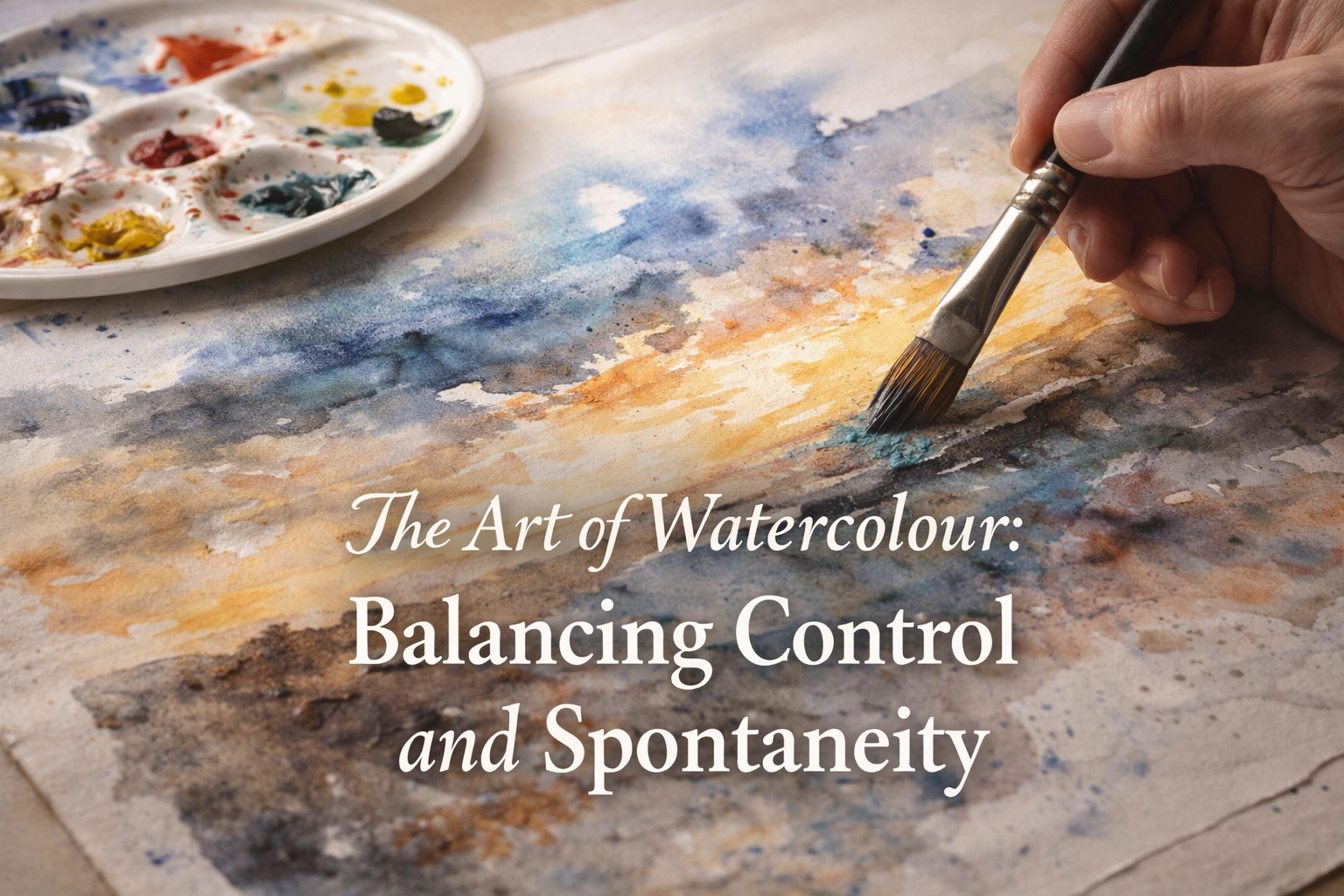
Watercolour is often described as one of the most challenging yet rewarding mediums in fine art. Its fluid nature demands both discipline and surrender—an understanding of technique, paired with the willingness to let the medium take its own course.
For me, watercolour is not just a method of painting; it is a dialogue between intention and unpredictability.
Understanding the Medium
Unlike acrylics or oils, watercolour does not allow for constant correction. Each stroke carries a sense of finality, making every decision deliberate. The transparency of the medium means that layers must be built carefully, preserving light rather than adding it later.
This process requires patience and clarity—knowing when to stop is just as important as knowing when to continue.
The Balance Between Control and Flow
One of the defining characteristics of watercolour is its ability to flow freely across the surface. While technique provides structure, it is the natural movement of water and pigment that brings life to the painting.
Too much control can make the work feel rigid. Too little can result in chaos.
The true essence lies in finding balance—guiding the medium without overpowering it.
The Importance of Timing
Timing plays a crucial role in watercolour painting. The same brushstroke can create entirely different effects depending on the moisture level of the paper.
- On wet paper, colours blend softly, creating atmospheric effects
- On dry paper, strokes remain sharp and defined
Understanding this timing allows the artist to shape the mood and depth of the artwork with precision.
Letting the Painting Breathe
In watercolour, what is left unpainted is just as important as what is filled in. The white of the paper often represents light, and preserving it creates a natural luminosity that defines the work.
Overworking a painting can diminish its freshness. Knowing when to step back is an essential part of the creative process.
A Medium That Reflects Life
There is a quiet philosophy within watercolour—it teaches acceptance. Not everything can be controlled, and not every outcome can be predicted. Yet, within that uncertainty, something meaningful often emerges.
This mirrors life itself.
Each painting becomes a reflection of this journey—an exploration of balance, patience, and trust in the process.
Conclusion
Watercolour is more than a technique; it is an experience. It challenges the artist to remain present, to adapt, and to find harmony between intention and flow.
In embracing both control and spontaneity, the medium reveals its true beauty—soft, expressive, and deeply human.